3-IPA — Clostridium sporogenes and indole-3-propionic acid science by Panacea Bio Chem

Evidence Ledger · Six Tiers

The evidence on 3-indolepropionic acid and metabolic health, sorted honestly

Every claim about 3-IPA and diabetes/metabolic health on this site traces to one of six tiers below. Each entry carries its PMID, its exact finding, and how it was verified. Nothing here is upgraded past what its own tier supports — an observational cohort stays an association; an animal study stays an animal study.

Compiled by Panacea Bio Chem Scientific Communications · concept: Bogdan Dicoias, Biochemist · every PMID below independently confirmed live against NCBI PubMed (title, authors, journal, year) on 2026-09-05 · ← back to the organism & pathway overview

Tier 1 · Mechanistic evidence

A receptor, enzyme or pathway is shown to be directly engaged.

Dodd D, Spitzer MH, Van Treuren W, et al. (2017). Nature. PMID 29168502
Characterises the Clostridium sporogenes fld gene cluster (fldA/fldL, fldI, fldB/fldC, fldH; locus tags CLOSPO_00309–00311) converting tryptophan (and phenylalanine/tyrosine) into nine circulating aromatic-amino-acid metabolites including 3-indolepropionate. Mutating fldC abolishes 3-IPA production.
Verified live via NCBI efetch (abstract); gene-cluster/locus-tag detail cross-confirmed against an independent 2022 review (PMID 36615808) after the primary PMC full text returned an access wall.
Liu Y, et al. (2022). Nature Microbiology. PMID 35505245
C. sporogenes uses reductive Stickland metabolism of amino acids, including the aromatic-amino-acid branch, to generate ATP — linking 3-IPA production to the organism's core energy metabolism rather than a side reaction.
Verified live via NCBI esummary (title/journal/year).
Venkatesh M, Mukherjee S, Wang H, et al. (2014). Immunity. PMID 25065623
3-IPA is a pregnane X receptor (PXR) ligand. In PXR-knockout (Nr1i2-/-) and Nr1i2-/-Tlr4-/- mice, 3-IPA downregulates enterocyte TNF-alpha and upregulates junctional-protein mRNAs, strengthening intestinal barrier function.
Verified live via NCBI efetch; abstract confirmed to name ONLY PXR, not AhR.
Huang ZB, et al. (2022). Frontiers in Cellular and Infection Microbiology. PMID 36299625
3-IPA "partially activates" the aryl hydrocarbon receptor (AhR) to promote macrophage phagocytosis and attenuate septic injury in a mouse sepsis model.
Verified live via Europe PMC (PMC9589056 → PMID) and NCBI esummary.
Tier 2 · In-vitro evidence

Cell-culture demonstrations — not yet a living organism.

Sari Z, Miko E, Kovacs T, et al. (2020). Cancers. PMID 32854297
3-IPA activates both AhR and PXR receptors and induces cytostatic effects plus oxidative stress in breast-cancer cell lines. An oncology in-vitro context, not a diabetes/metabolic finding.
Verified live via NCBI esummary.
Sehgal R, et al. (2021). Nutrients. PMID 34684510 (in-vitro component)
3-IPA reduces activation markers in hepatic stellate cells in vitro, alongside the human cohort finding listed under Tier 4 below.
Verified live via Europe PMC (PMC8538297 → PMID).
Tier 3 · Animal evidence

Demonstrated in a live animal model — not yet human data.

Wikoff WR, Anfora AT, Liu J, et al. (2009). PNAS. PMID 19234110
Germ-free mice produce no detectable 3-IPA. Mono-colonisation with Clostridium sporogenes alone restores production — the foundational organism-to-metabolite causal demonstration.
Verified live via NCBI efetch, exact sentence quoted from the abstract.
Ballanti M, et al. (2024). Pharmacological Research. PMID 38734193 (mouse arm)
3-IPA treatment improved glucose tolerance and Akt phosphorylation in skeletal muscle in mice.
Verified live via NCBI efetch. (Human arm of the same paper listed under Tier 4.)
Zhao ZH, et al. (2019). Experimental & Molecular Medicine. PMID 31506421
3-IPA inhibits gut dysbiosis and endotoxin leakage, attenuating steatohepatitis in rats.
Verified live via Europe PMC (PMC6802644 → PMID).
Xue H, et al. (2022). Circulation Research. PMID 35893593 (mouse arm)
Dietary 3-IPA supplementation reduces atherosclerotic plaque development in ApoE-knockout mice via reverse-cholesterol-transport promotion.
Verified live via Europe PMC title search. (Human cohort arm listed under Tier 4.)
Krause FF, et al. (2024). Gut Microbes. PMID 39397690
Clostridium sporogenes-derived metabolites (the mixture, not 3-IPA in isolation) protect mice against colonic inflammation.
Verified live via Europe PMC (PMC11485882 → PMID).
Du L, et al. (2024). Microbiology Spectrum. PMID 38916334 — the contradicting finding
Direct oral C. sporogenes supplementation (the organism, six weeks) increased body weight, fat mass, adipocyte size, serum triglycerides and hepatic lipogenesis gene expression in mice via enhanced intestinal energy/carbohydrate/fat absorption, despite unchanged feed intake. See the dedicated organism-vs-metabolite page for full treatment.
Full abstract verified live via Europe PMC (PMC11302664 → PMID).
Tier 4 · Observational human evidence

Human association — nothing was administered or manipulated.

de Mello VD, Paananen J, Lindstrom J, et al. (2017). Scientific Reports. PMID 28397877 — the Finnish cohort
"Indolepropionic acid and novel lipid metabolites are associated with a lower risk of type 2 diabetes in the Finnish Diabetes Prevention Study" — a prospective cohort; higher serum 3-IPA associated with lower incident type 2 diabetes.
Full title, complete author list, journal and date verified live via esummary after a direct title-search (the broad "IPA + type 2 diabetes" search did not surface it directly). This is a prospective cohort association, not an interventional trial.
Ballanti M, et al. (2024). PMID 38734193 (human arm)
Decreased circulating 3-IPA identifies subjects with insulin resistance, overweight, low-grade inflammation and dysregulated branched-chain-amino-acid metabolism, in a multi-omics human study.
Verified live via NCBI efetch.
Sehgal R, et al. (2021). PMID 34684510 (human arm)
Circulating 3-IPA is lower in individuals with hepatic fibrosis than those without — a protective-direction association.
Verified live via Europe PMC; association direction confirmed.
Xue H, et al. (2022). PMID 35893593 (human arm)
Integrated microbiome-metabolome analysis of coronary artery disease patients vs. controls (n=30+30), replicated in an independent atherosclerotic-cardiovascular-disease cohort (n=256) — lower 3-IPA associated with disease.
Verified live via Europe PMC title search.
Tier 5 · Interventional human evidence

Something was actually manipulated in living people.

Gao J, et al. (2021). Diabetes Care. PMID 34253560
A randomized controlled-feeding trial in which the manipulated variable was diet (fried vs. non-fried meat), not 3-IPA. Fried-meat consumption lowered fecal 3-indolepropionic acid (and valeric/butyric acid); changes in these fecal cometabolites significantly associated with changes in insulin-sensitivity markers (IGI/MIRI).
Verified live via NCBI efetch. Classification caveat is load-bearing: this is interventional evidence about diet, with 3-IPA as a measured correlate — never "an IPA trial".
NCT07739602 (ClinicalTrials.gov, registry-confirmed)
A completed randomized trial of Cornelian cherry (Cornus mas) fruit lyophilizate vs. placebo in metabolic-syndrome patients (Wroclaw Medical University). Fecal indole-3-propionic acid is a named secondary outcome ("Change in Fecal Indole Metabolite Concentrations") alongside OGTT/insulin measures. Results not yet posted (hasResults=false).
Fetched live from the ClinicalTrials.gov API v2 study record, 2026-09-05. This is not a 3-IPA-administration trial — the polyphenol fruit product was the intervention; 3-IPA was measured, not given.
Trial-status ledger: a dedicated 3-IPA/indole-3-propionic acid human-administration trial
OBSERVED_IN_SEARCH — CORRECTED 2026-09-10. Re-running this page's own documented query ("indole-3-propionic acid", ClinicalTrials.gov API v2) on 2026-09-10 returns 13 studies, including three registered trials that administer 3-IPA itself, all from the iPROACT programme at Glostrup University Hospital, Copenhagen (dietary-supplement indole-3-propionic acid vs. placebo; results not posted for any): NCT06674018 (iPROACT-pilot, completed 2025-02-25, 79 participants, healthy volunteers, first posted 2024-11-05), NCT07105514 (iPROACT-pilot2, recruiting, 32 participants estimated, first posted 2025-08-06) and NCT07318129 (iPROACT-MS, recruiting, 220 participants estimated, relapsing-remitting multiple sclerosis, completion estimated 2028-07-15, first posted 2026-01-05). None of the three tests a diabetes or glucose-regulation endpoint, so that specific gap is unchanged. All three were first posted before the 2026-09-05 search below, which recorded only 2 hits — the earlier return cannot be reconciled with the registry's first-posted dates, and both dated readings are kept on record.
Superseded 2026-09-05 search record, kept for the record: NOT_OBSERVED_IN_SEARCH. Searched ClinicalTrials.gov API v2, 2026-09-05, query strings: "indole-3-propionic acid" (2 hits, both off-target — one withdrawn vein-graft study, one the Cornelian-cherry trial above), "indolepropionic acid diabetes" (0 hits), "indole propionic acid supplementation" (2 hits, neither an IPA-administration trial), "tryptophan metabolite type 2 diabetes microbiome" (2 hits, neither an IPA-administration trial). The 2026-09-10 correction fetched all three full study records live from the ClinicalTrials.gov API v2.
Inclusion definition used: a registered interventional study in which 3-IPA itself (or a purified/synthetic preparation of it) is the administered product. EU Clinical Trials Register, WHO ICTRP, and Chinese/Japanese trial registries were not queried this pass — recorded as owed, not concluded empty.

Tier 6 · Unproven hypothesis

Plausible extrapolation — not tested this way by any study located.

3-IPA (or a C. sporogenes-based probiotic) could be developed as a preventive or adjunct approach for type 2 diabetes / metabolic syndrome. Extrapolated in review literature (Jiang H, et al., 2022, Nutrients, PMID 36615808; Roager & Licht, 2018, Nature Communications, PMID 30120222) from the mechanistic, cohort and animal evidence above.
Explicitly not established by any interventional human evidence located this pass. Must never be stated as a therapeutic claim.
3-IPA's antioxidant/free-radical-scavenging capacity meaningfully contributes to its metabolic-health associations in humans.
Basis: in-vitro/chemistry characterisation and a 2025 neuroprotection review (PMID 40942152), not a demonstrated mechanism in the diabetes-cohort papers themselves.
Clostridium sporogenes probiotic supplementation would be a beneficial, low-risk way to raise 3-IPA in humans.
Unresolved, and actively complicated by the Du et al. 2024 mouse adipogenesis finding above. No human C. sporogenes-supplementation trial located.

Contradictions and unresolved questions

Organism-level vs. metabolite-level effect Giving mice the bacterium (Du 2024) produced a metabolically unfavourable outcome in one study; giving mice or associating humans with the molecule the bacterium makes has shown favourable directions in several other studies. These are not the same claim and are never blended on this site.
Causal direction, unresolved Every human arm above is cohort/cross-sectional except the Gao 2021 diet-manipulation trial, where 3-IPA is a measured correlate of a dietary change, not the administered agent. Whether raising 3-IPA causes better glucose regulation, or simply marks a fibre-fermenting, tryptophan-processing gut ecosystem that independently associates with better metabolic health, remains open. Falsifying evidence would be an adequately powered RCT that raises 3-IPA with no effect on glucose/insulin endpoints — not located.
Receptor mechanism, not over-generalised No paper reviewed combines PXR and AhR engagement with a diabetes-specific outcome in one study. Each receptor claim is sourced to its own paper and physiological context (gut barrier / sepsis-immunity / breast-cancer cell lines) — never merged into "3-IPA works through PXR and AhR to improve blood sugar."

Not established

QuestionStatus
Does raising 3-IPA cause improved glucose regulation in humans?Not established — no interventional human trial located
Does taking 3-IPA or a C. sporogenes supplement lower diabetes risk in people?Not established
Is C. sporogenes probiotic supplementation net-beneficial for human metabolic health?Genuinely unresolved — complicated by the Du 2024 mouse finding
What is the relative contribution of C. sporogenes vs. other fld-cluster-carrying species to a typical human's circulating 3-IPA?Not established in humans (only shown in gnotobiotic mice)

This ledger reflects a literature pass completed 2026-09-05 (22 NCBI E-utilities calls, 8 Europe PMC REST calls, 4 ClinicalTrials.gov API v2 calls); the trial registry was re-run and the trial-status record corrected on 2026-09-10 (4 further ClinicalTrials.gov API v2 calls). A tighter-than-annual re-scan is warranted given the publication rate observed in this specific literature. EU/WHO/Chinese/Japanese trial-registry search and a deeper Russian/Chinese literature pass remain owed and are not represented as completed.

The Panacea Technology Universe

26 technologies, each the leader of its class

Proprietary Panacea Bio Chem Ltd technologies, invented by Bogdan Dicoias — what each one does, and why it leads its class.

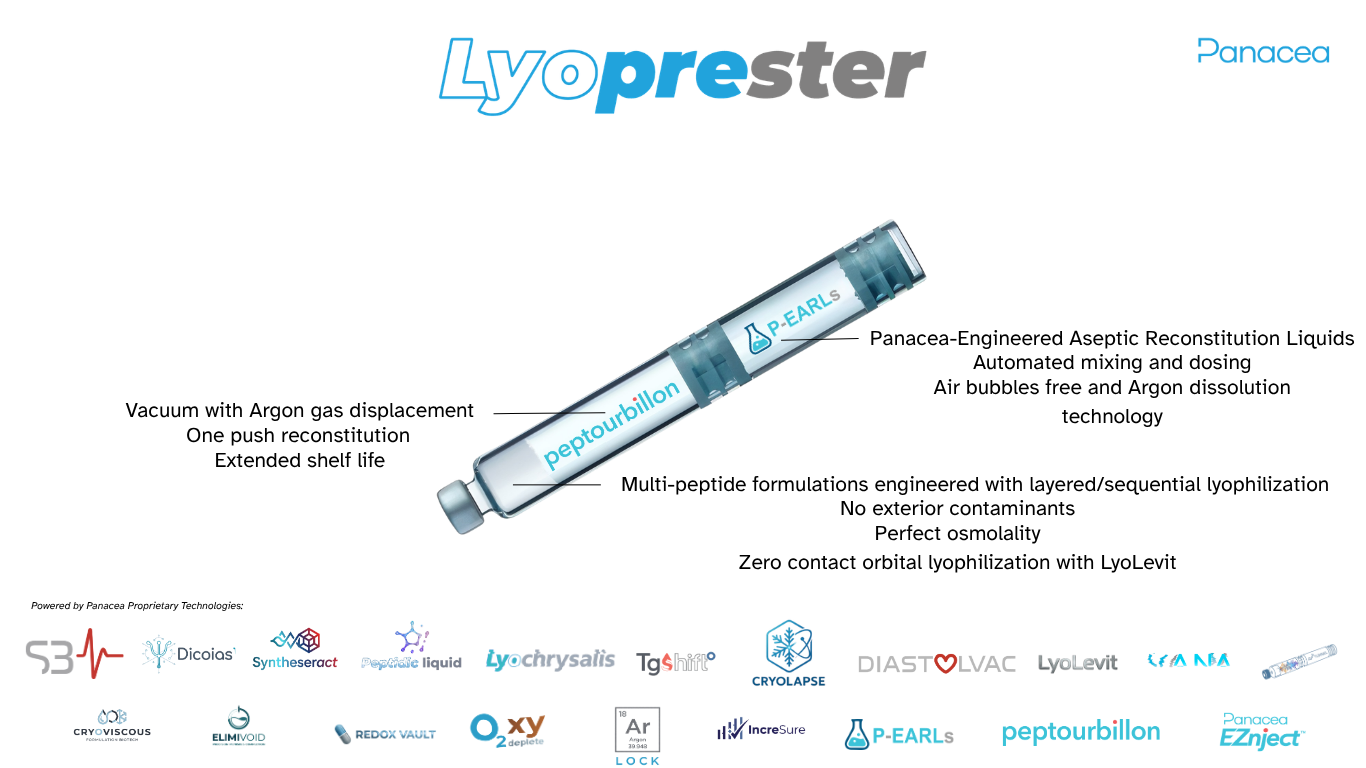
Lyoprester® technology convergence — the Panacea Bio Chem technologies that meet inside one cartridge, invented by Bogdan Dicoias
Lyoprester® — Panacea Bio Chem technology by Bogdan DicoiasLyoprester®The only dual-chamber cartridge that is autoreconstitution-enabled, vacuum-sealed and argon-fillback.lyoprester.com ↗P-EARLs — Panacea Bio Chem technology by Bogdan DicoiasP-EARLs™Panacea-Engineered Aseptic Reconstitution Liquid(s) — each tuned to the peptide it wakes.p-earls.com ↗Peptourbillon — Panacea Bio Chem technology by Bogdan DicoiasPeptourbillon™The layered peptide formulation architecture — single- or multi-layer, never a blend.peptourbillon.com ↗RF Tunnel — Panacea Bio Chem technology by Bogdan DicoiasRF Tunnel™The RF-formed central channel through the cake.rftunnel.com ↗TgShift — Panacea Bio Chem technology by Bogdan DicoiasTgShift™Raises the cake’s glass-transition temperature with RF — instead of chilling below it.tgshift.com ↗Cryolapse — Panacea Bio Chem technology by Bogdan DicoiasCryolapse™Cryogenic pressure collapse under S3Pulse™ control — vapour redistributed through the whole cake, not its surface, impeding crust formation.cryolapse.com ↗LyoLevit — Panacea Bio Chem technology by Bogdan DicoiasLyoLevit™The cake levitates and spins in high orbit — driven by ultrasound and RF.lyolevit.com ↗Lyochrysalis — Panacea Bio Chem technology by Bogdan DicoiasLyochrysalis™The integrated chamber housing the whole drying stack.lyochrysalis.com ↗S3Pulse — Panacea Bio Chem technology by Bogdan DicoiasS3Pulse™The control brain for every piece of Panacea hardware.s3pulse.com ↗Liquiprester — Panacea Bio Chem technology by Bogdan DicoiasLiquiprester™The single-liquid cartridge engineered so multiple peptide APIs coexist in one shared vehicle.liquiprester.com ↗Syntheseract — Panacea Bio Chem technology by Bogdan DicoiasSyntheseract™Continuous-flow peptide synthesis in a special, very fast and economical way.syntheseract.com ↗CFSPPS — Panacea Bio Chem technology by Bogdan DicoiasCFSPPS™Continuous-flow solid-phase peptide synthesis, written as its own category.cfspps.com ↗OxyDeplete — Panacea Bio Chem technology by Bogdan DicoiasOxyDeplete™Degassing plus no-headspace doctrine — the oxygen-starved seal.oxydeplete.com ↗ArgonLock — Panacea Bio Chem technology by Bogdan DicoiasArgonLock™The final inert-atmosphere lock under argon.argonlock.com ↗RedoxVault — Panacea Bio Chem technology by Bogdan DicoiasRedoxVault™Separation, not merely suppression — redox isolation in lipid micro-reservoirs.redoxvault.com ↗PleniDose — Panacea Bio Chem technology by Bogdan DicoiasPleniDose™The shared filling gantry — one machine filling both the dual-chamber Lyoprester and the liquid Liquiprester.plenidose.com ↗IncreSure — Panacea Bio Chem technology by Bogdan DicoiasIncreSure™The dose-metrology layer — verified API per pen increment.incresure.com ↗ElimiVoid — Panacea Bio Chem technology by Bogdan DicoiasElimiVoid™Front-void elimination without touching the metered dose.elimivoid.com ↗Cryoviscous — Panacea Bio Chem technology by Bogdan DicoiasCryoviscous™The characterised cold, high-viscosity, low-mobility conditioning state.cryoviscous.com ↗Vana Machine — Panacea Bio Chem technology by Bogdan DicoiasVana Machine™Vacuum–Argon–Nitrogen Architecture — draws the air and nitrogen out of the cake and backfills with argon; in a separate process, the same machine makes the P-EARLs bubble-free.www.vanamachine.com ↗EZnject — Panacea Bio Chem technology by Bogdan DicoiasEZnject™The disposable auto-injector pen built around the Lyoprester.panaceaeznject.com ↗Dicoias Ψ — Panacea Bio Chem technology by Bogdan DicoiasDicoias ΨThe computed-chemistry advisory — every substance reduced to a vector across physical, electronic and formulation space.dcppsi.com ↗SealoPrester — Panacea Bio Chem technology by Bogdan DicoiasSealoPrester™Aseptic Cartridge Closure System — Seal o’ Precision + Sterility.sealoprester.com ↗Peptidic Liquid — Panacea Bio Chem technology by Bogdan DicoiasPeptidic LiquidThe peptide formulation in solution — the active plus its buffers, cryoprotectants, lyoprotectants and scaffolders.peptidicliquid.com ↗DiastolVAC — Panacea Bio Chem technology by Bogdan DicoiasDiastolVAC™Biomimetic diastolic vacuum control — the pneumatic circulatory system of the machine: pumps, valves and sensors as one ensemble.diastolvac.com ↗KineticON — Panacea Bio Chem technology by Bogdan DicoiasKineticON™Motion Integrity Architecture — the motion-control layer that lets the machine know what happened on every axis move.kineticon.org ↗